The Most Common Bible Verses Christian Singles Hear—and the Context Questions Nobody Asks
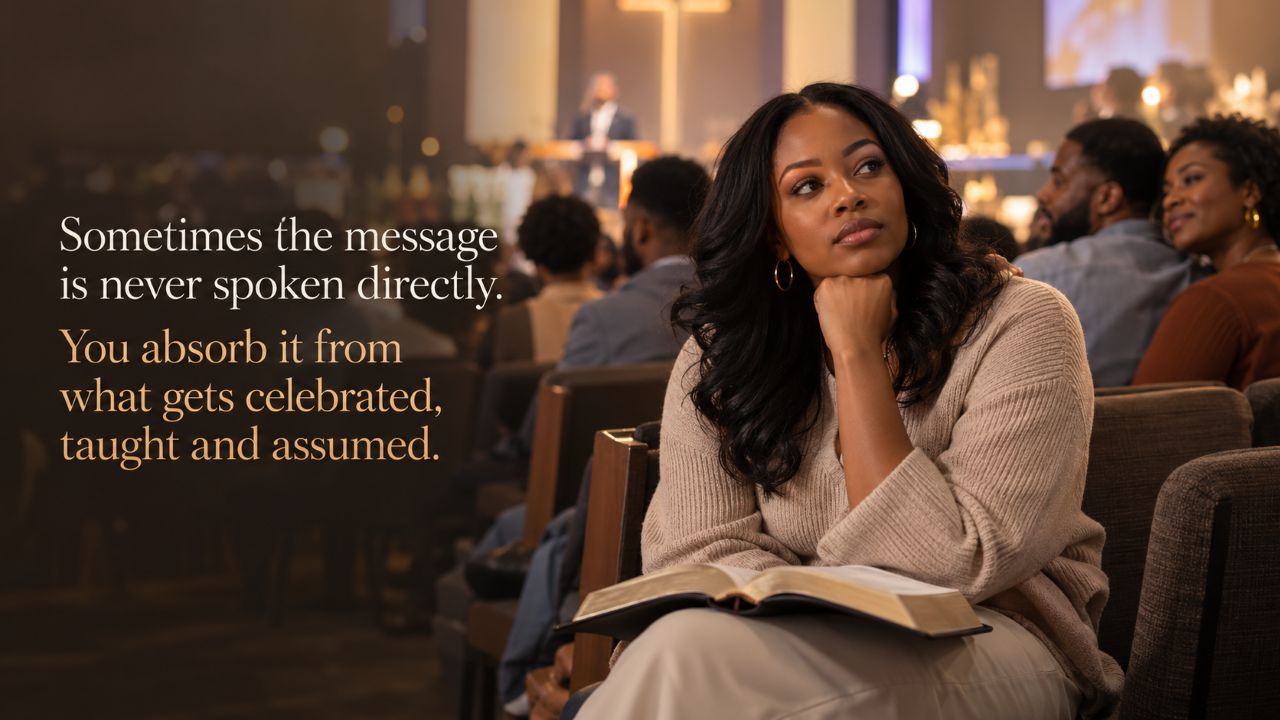 You have probably heard the verses.
“It is not good for man to be alone.”
“Delight yourself in the Lord, and He will give you the desires of your heart.”
“Seek first the kingdom of heaven.”
Maybe someone quoted one after you admitted that you still want to get married.
Maybe another appeared beneath a social media post telling singles to “use this season to prepare.”
Nobody meant harm.
But after years of hearing the same verses, you may have quietly absorbed a conclusion nobody actually said out loud:
If I become spiritually healthy enough, content enough, prayerful enough, or useful enough, eventually God will move me out of singleness and into the part of life I have been preparing for.
And when that does not happen?
You start wondering whether you missed something.
That is precisely when we need to stop quoting Bible verses—and start studying them.
Because the question is not merely, “Is this verse true?”
The better question is:
“Does this verse mean what we have been using it to mean?”
“It Is Not Good for Man to Be Alone”
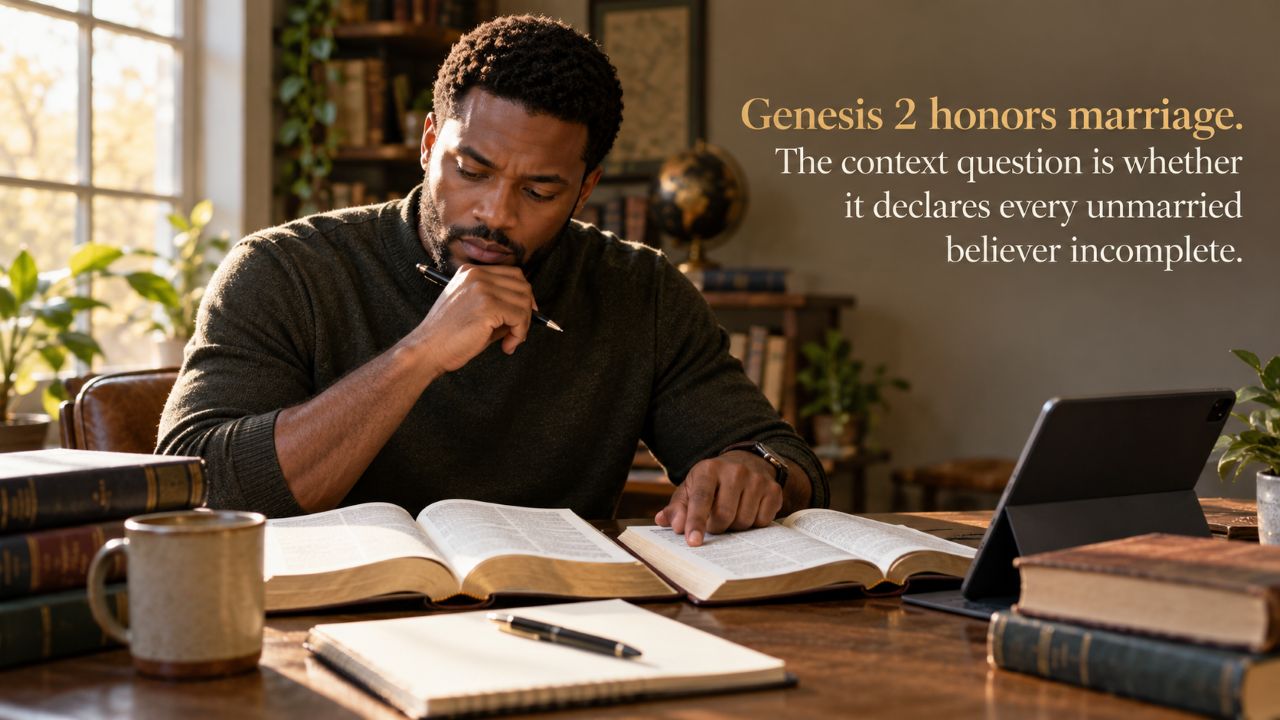
Genesis 2:18 may be one of the most familiar passages in Christian conversations about relationships: God says that it is not good for the man to be alone and that He will make a suitable helper for him.
The passage absolutely matters for biblical theology of marriage.
But notice the context question we rarely ask:
Is Genesis 2:18 describing Adam's particular situation in the creation narrative, or declaring that every unmarried adult exists in a condition God calls “not good”?
Those are not the same statement.
If the second interpretation were absolute, the New Testament would become very difficult to explain.
Jesus lived unmarried.
Paul lived unmarried when he wrote 1 Corinthians and explicitly said that remaining unmarried could be good. In 1 Corinthians 7:7–8, Paul describes differing gifts from God and tells unmarried people and widows that remaining unmarried, as he was, can be good.
Genesis 2 honors marriage.
It does not require us to conclude that an unmarried Christian is an incomplete human being.
The distinction matters.
“God Will Give You the Desires of Your Heart”
Then there is Psalm 37:4:
Take delight in the Lord, and He will give you the desires of your heart.
 For a Christian who desires marriage, that can quickly become a formula:
If I delight in God enough, God will eventually give me the spouse I desire.
But Psalm 37 is not a marriage promise.
Read the surrounding Psalm and the subject is much larger: trusting God while watching wicked people appear to prosper, refusing envy, committing your way to the Lord, practicing faithfulness, and trusting God's justice.
Marriage is not the subject.
That does not mean your desire for marriage is wrong.
It means Psalm 37:4 should not be turned into a contractual guarantee that every legitimate desire will eventually become a specific life circumstance.
You can deeply desire marriage without claiming God promised it.
Those two truths can coexist.
“Seek First the Kingdom of heaven”—And Then God Will Send Someone?
Matthew 6:33 can receive similar treatment.
Jesus tells His listeners to seek God's kingdom and righteousness first. But look at what comes immediately before it: food, drink, clothing and anxiety about material necessities. Jesus is teaching His disciples not to organize their lives around anxious pursuit because their Father knows their needs.
The passage never says:
Seek God first, and He will reward you with a spouse.
Yet singles can subtly hear it that way.
Serve more.
Pray more.
Become content.
Stop looking.
Then God will send someone.
Now spiritual disciplines become a strategy for changing relationship status.
And that can create a painful theological problem: when marriage does not happen, you begin auditing yourself.
Am I not content enough?
Did I want marriage too much?
Is God waiting for me to learn something?
Perhaps the better question is whether Scripture ever told you that marriage was the graduation ceremony for successful singleness.
What Paul Says That We Rarely Say
 This is where 1 Corinthians 7 becomes especially uncomfortable for modern Christian culture.
Paul does not merely tolerate unmarried Christians.
He discusses ways unmarried life can create distinctive opportunities for devotion to God. In verses 32–35, he contrasts responsibilities accompanying marriage with the unmarried person's potential for focused attention toward “the Lord's affairs.” His stated concern is not restricting people, but encouraging ordered, undistracted devotion.
That does not mean married Christians are spiritually inferior.
And it does not mean every single Christian must enjoy singleness.
It means the New Testament refuses to describe unmarried adulthood merely as the hallway leading to marriage.
There is something to do here.
There is discipleship here.
There is obedience here.
There is purpose here.
Isaiah 56 gives us an even more striking biblical picture. In a world where descendants were deeply connected to legacy, God promises faithful eunuchs—a group without the conventional path to children—a “name better than sons and daughters” and an enduring place among His people.
Think about that.
Scripture itself challenges the assumption that marriage and biological family are the only routes to significance, belonging, legacy, or a meaningful future with God.
Start Asking Better Questions of Familiar Verses
The next time someone quotes a familiar verse about your singleness, you do not have to become defensive.
 Become curious.
Ask:
Who is speaking?
To whom?
What problem is the passage addressing?
What comes before and after this verse?
Is this a command, description, promise, proverb, principle, or narrative?
Does the passage actually mention marriage—or have we brought marriage into it?
And perhaps most importantly:
Would I interpret this verse the same way if I were already married?
That one question can expose a remarkable amount of inherited theology.
Because sometimes the Bible is not telling you to stop wanting marriage.
It is challenging what you have started believing marriage will prove.
Marriage can be desired without becoming required for identity.
Grief can be acknowledged without becoming a theology of incompleteness.
And your present life does not have to be treated as rehearsal for another one.

If you are ready to examine those beliefs more deeply, Marriage Desired, Not Required: A Biblical Guide to Wanting a Spouse Without Waiting for Marriage to Validate Your Life was created for exactly that conversation.
It is not about convincing you to stop wanting marriage.
It is about separating what Scripture actually teaches from assumptions Christian culture may have taught you to carry.
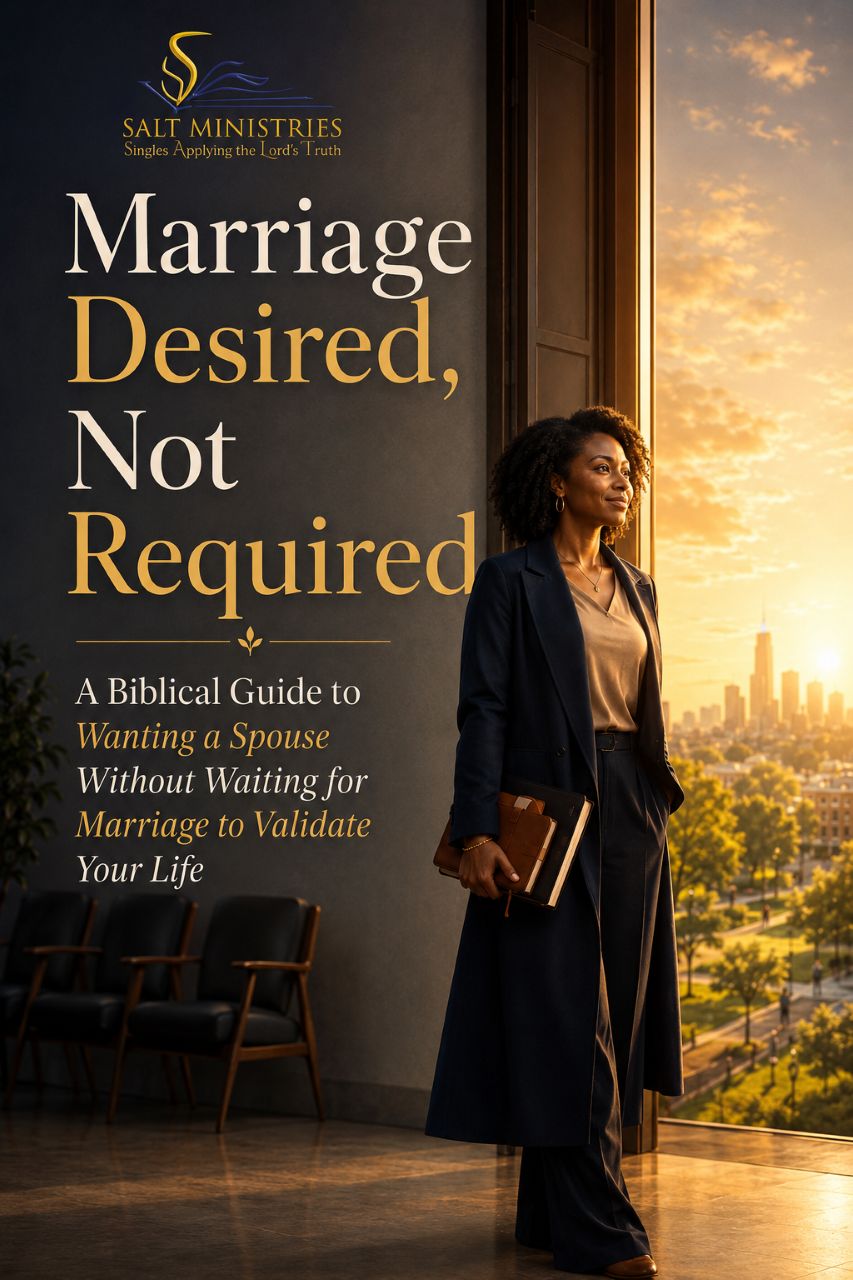
Get the details and two bonuses here, and begin examining the theology underneath the waiting.
Because you can still want the wedding without living in the waiting room.
Marriage may become part of your story. It was never meant to become the permission slip that allows your life to begin.