Does Your Life Matter Before Marriage? The Bible’s Answer May Surprise You
When Did Marriage Become the Church’s Unofficial Finish Line?
 You can love your church and still feel invisible inside it.
You can faithfully serve, give, pray, study Scripture, disciple people, lead ministries, care for aging parents, build a career, pour into your community—and somehow still feel like everyone is waiting for the real story to begin.
Then one Sunday, another marriage series starts.
Another couples’ event fills the calendar.
Another Mother’s Day or Father’s Day recognition comes around.
Another well-meaning person asks, “So…are you seeing anybody yet?”
And nobody actually says your life doesn’t matter.
That would be too obvious.
But sometimes church culture communicates something without ever putting it into words:
Marriage is adulthood. Marriage is arrival. Marriage is where the important Christian life begins.
And if you have been single long enough, that message does something deeper than make you lonely.
It makes you feel unseen.
And Sometimes What You’re Feeling Is Grief
There is a particular grief long-term Christian singles rarely receive permission to name.
 You may be grieving something you have never actually had.
The husband you thought would be beside you by now.
The wife you imagined building a home with.
The children you assumed would already be calling you Mom or Dad.
The anniversaries.
The family traditions.
The future you quietly expected because somewhere along the way you absorbed the idea that faithful Christians eventually marry.
Nobody died.
So, nobody brings a casserole.
There is no funeral for a future that hasn’t happened.
And because marriage is still possible, you may even feel guilty grieving it.
So, you keep serving.
Keep smiling.
Keep saying, “God’s timing.”
But somewhere underneath all of it is a question you may be afraid to say out loud:
Does My Life Matter to God Right Now—or Will It Matter More Once I’m Married?
 That question deserves more than encouragement.
It deserves an open Bible.
Because the biblical answer is far stronger than, “Don’t worry, God has somebody for you.”
The Bible does not tell unmarried Christians that their lives are incomplete versions of married lives.
In fact, Scripture repeatedly disrupts the assumption that marriage and biological family are the measurements of spiritual significance.
Start with Isaiah.
The eunuch in Isaiah 56 describes himself as “a dry tree”—someone without the ordinary expectation of descendants or family legacy.
God’s answer is remarkable.
To those who hold fast to His covenant, God promises a place and a name “better than sons and daughters” and an everlasting name that will not be cut off (Isaiah 56:3–5).
Read that again.
God does not say, “Don’t worry. Eventually I’ll give you the traditional family structure everybody else has.”
He gives them something that completely overturns the assumption that significance requires biological legacy.
Jesus Doesn’t Treat Singleness Like a Spiritual Deficiency Either
 When Jesus discusses marriage in Matthew 19, He acknowledges people who live outside marriage—including those who do so “for the sake of the kingdom of heaven” (Matthew 19:10–12).
That matters.
Jesus does not describe every unmarried adult as somebody whose life is temporarily malfunctioning.
And then He does something even more radical with the definition of family.
When told that His mother and brothers were looking for Him, Jesus looked at His disciples and said:
“Whoever does God’s will is my brother and sister and mother.”
(Mark 3:31–35)
Jesus is not dishonoring biological family.
He is revealing that the Kingdom creates a family that cannot be reduced to marriage, children, and household structure.
Which means the unmarried Christian standing in your sanctuary is not a person waiting to become part of a real family.
In Christ, they already belong.
Then Paul Says Something We Rarely Build Singles Ministries Around
First Corinthians 7 may be one of the most talked-about chapters on marriage and one of the least taken seriously chapters on singleness.
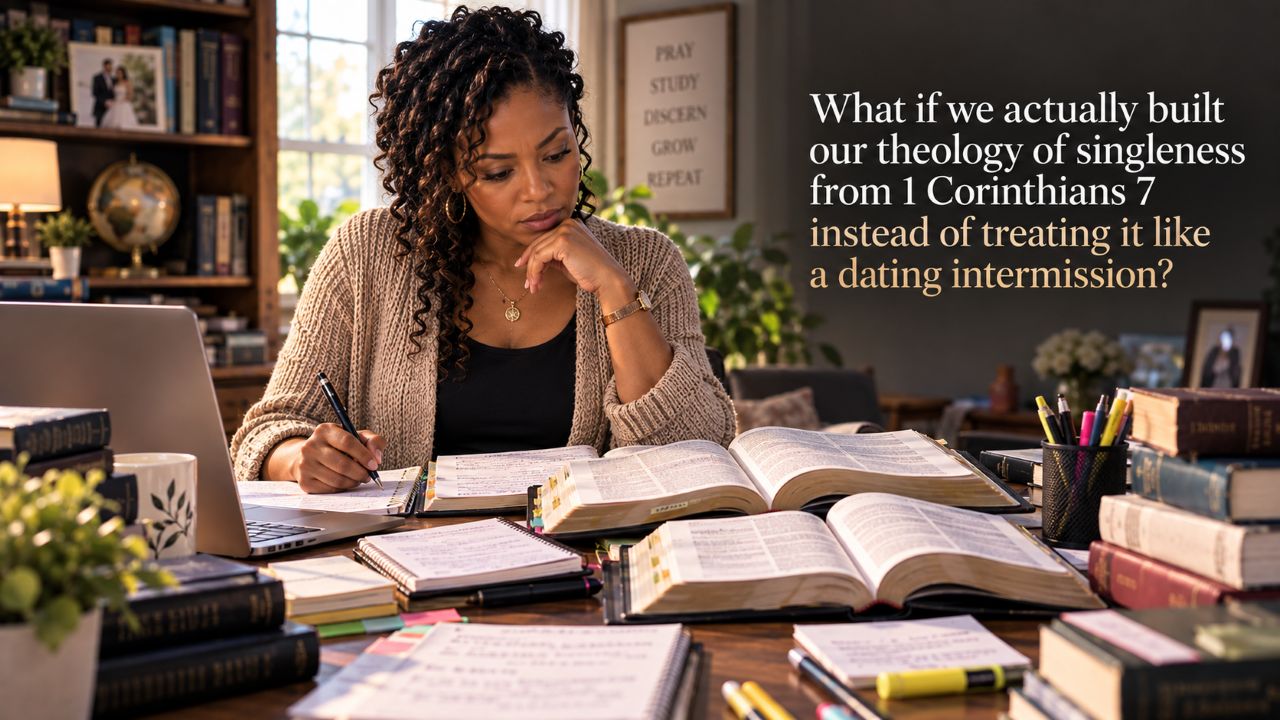 Paul writes:
“Each of you has your own gift from God; one has this gift, another has that.”
Then he tells unmarried believers that remaining unmarried can be good (1 Corinthians 7:7–8).
Not tolerable.
Not tragic-but-manageable.
Good.
Later, Paul explains one reason.
The unmarried believer has an opportunity for focused concern regarding “the Lord’s affairs” and pleasing the Lord. Paul says his purpose is not to restrict believers, but to promote what is proper and “undivided devotion to the Lord” (1 Corinthians 7:32–35).
The Greek adverb translated “undistracted” or “undivided” in verse 35 is aperispastōs—carrying the idea of being without distraction or being pulled away. (Source: The Complete Word Study Dictionary – New Testament)
Notice what Paul does not say.
“Since you aren’t married yet, stay busy until somebody chooses you.”
He gives unmarried life theological purpose.
That changes the conversation.
Marriage Should Be Honored. It Just Shouldn’t Be Worshiped.
 Scripture absolutely honors marriage.
Hebrews 13:4 says marriage should be held in honor.
So, this is not an argument against marriage.
It is an argument against quietly turning marriage into a category Scripture never gives it:
the doorway into a meaningful Christian life.
Jesus did not need a wedding to validate His earthly obedience.
Paul did not need a spouse before the Church took his calling seriously.
And Scripture never tells single believers to postpone spiritual maturity, intimacy with God, service, stewardship, discipleship, leadership, learning, building, or purpose until marriage happens.
Your Wedding Is Not Your Starting Line
Maybe the question is no longer:
“When will God finally move me out of singleness?”
Maybe there is another question you need to study:
“What has God designed this part of my life to produce in me that I keep postponing because I thought this was only the waiting room?”
 You can desire marriage without making marriage the proof that your life matters.
You can grieve what has not happened without calling the life God has given you meaningless.
And the Church can celebrate marriage without treating single Christians like unfinished families, incomplete adults, or ministry projects waiting for a spouse.
Your life does not become valuable when somebody meets you at an altar.
Your purpose does not activate when somebody puts a ring on your hand.
Your opportunity to know God intimately did not get scheduled for after the honeymoon.
Your life with God is already happening.
And perhaps the Church needs to stop asking only when you are getting married—
and start asking what God is doing through the life you are already living.
That is the conversation S.A.L.T. wants to have.
Not with clichés.
Not with another lesson about “waiting well.”
With studying what the Bible actually says.
Sources & Study References
- Isaiah 56:3–5 — God’s promise to the eunuch of a place and enduring name beyond biological descendants. NIV.
- Matthew 19:10–12 — Jesus’ teaching concerning those who live outside marriage, including for the Kingdom. NIV.
- Mark 3:31–35 — Jesus’ expansion of family around those who do God’s will. NIV.
- 1 Corinthians 7:7–8, 32–35 — Paul on differing gifts, unmarried life, the Lord’s affairs, and undivided devotion. NIV/NET.
- Greek: aperispastōs (ἀπερισπάστως), 1 Corinthians 7:35 — “undistractedly/without distraction.” Greek lexical reference. (Source: The Complete Word Study Dictionary – New Testament)
- Hebrews 13:4 — the biblical command to honor marriage. NIV.