The Church Has Accidentally Turned Marriage Into a Spiritual Promotion
Nobody has to stand at the pulpit and say, “Married Christians matter more.”
The message can arrive without a sentence.
It happens when the “next stage” after young adulthood is marriage. When adult examples in sermons usually involve spouses and children. When singles are taught to “wait well,” while married adults are invited to build, lead, mentor, and leave a legacy.
Not every church does this. Few intend to.
But the effect can still be powerful: marriage begins to feel less like one biblical vocation and more like a spiritual promotion.
After enough years, a single Christian can quietly absorb the theology:
My life is faithful—but not fully formed yet.
Scripture Does Not Put a Wedding Between You and Christian Adulthood
 Marriage is good. Scripture never asks us to diminish it.
Genesis 2 clearly presents the union of man and woman as part of God’s good creation and establishes the one-flesh marriage relationship.
But Genesis 2 is not the last thing Scripture says about faithful adult life.
The New Testament must also shape a biblical view of singleness.
Jesus lived unmarried. Paul writes from an unmarried state and says it can be good to remain as he is. Neither life can reasonably be described as Christianity on pause.
More importantly, Jesus explicitly acknowledges people who would live unmarried “for the sake of the kingdom of heaven” in Matthew 19:10–12. He does not describe that life as a spiritual emergency waiting to be corrected.
Paul goes further in 1 Corinthians 7.
Speaking about unmarried believers, he explains that marriage brings legitimate responsibilities toward a spouse, while unmarried life can provide a particular freedom for attention to “the Lord’s affairs.” His stated concern is devotion to the Lord without distraction.
The Greek word in 1 Corinthians 7:35 is aperispastōs—without distraction. (Source: The Complete Word Study Dictionary – New Testament)
The Amplified Version of this scripture says, “secure undistracted devotion to the Lord.”
That is not waiting-room language.
The Bible’s Question Is Not “Who Chose You?”
 Church culture can accidentally train singles to measure progress by milestones:
Dating. Engagement. Wedding. Children.
Scripture measures faithfulness differently.
In Mark 3:31–35, Jesus expands the language of family around obedience to God. His followers become brother, sister, and mother. Belonging in the kingdom is therefore not limited to the biological family you were born into or the one you may someday create.
Isaiah 56 makes the point even sharper.
The eunuch describes himself as a “dry tree”—someone without the ordinary possibility of descendants. Yet God promises the faithful eunuch a lasting name “better than sons and daughters.”
Think about that.
The very passage that names the absence of biological legacy refuses to treat that absence as the end of significance.
The kingdom does not measure your value by whether someone married you.
Why This Hurts More Than Loneliness
 For many long-term Christian singles, the deepest pain is not simply an empty chair at dinner.
It is invisibility.
You can love God, know Scripture, mentor younger believers, care for family, build meaningful work, give generously, serve faithfully—and still feel as though everyone is waiting for your “real life” to begin.
Then grief enters.
Not only grief over being unmarried, but grief over a future you thought would already exist by now.
That grief is real.
But grief is not proof that your life is defective.
And desire is not the same thing as deficiency.
Stop Asking Marriage to Prove What Christ Already Settled
 Here is a question worth sitting with:
What have I started believing marriage would prove about me?
That you are wanted?
Mature?
Normal?
Chosen by God?
Finally, part of a family?
Those are much deeper questions than, “Do I want a spouse?”
You can genuinely desire marriage while refusing to make marriage carry the weight of your identity.
And that changes how you live now.
You stop postponing obedience until someone arrives.
You build friendships intentionally.
You develop your gifts.
You serve from calling instead of from a holding pattern.
You grieve honestly without treating grief as a prophecy about your future.
Marriage may change your responsibilities someday.
But it does not upgrade your value.
You Can Want the Wedding Without Living in the Waiting Room
If this has named something you have felt for years, the next step is not forcing yourself to want marriage less.
It is examining the theology underneath the waiting.
That is why S.A.L.T. created Marriage Desired, Not Required: A Biblical Guide to Wanting a Spouse Without Waiting for Marriage to Validate Your Life.
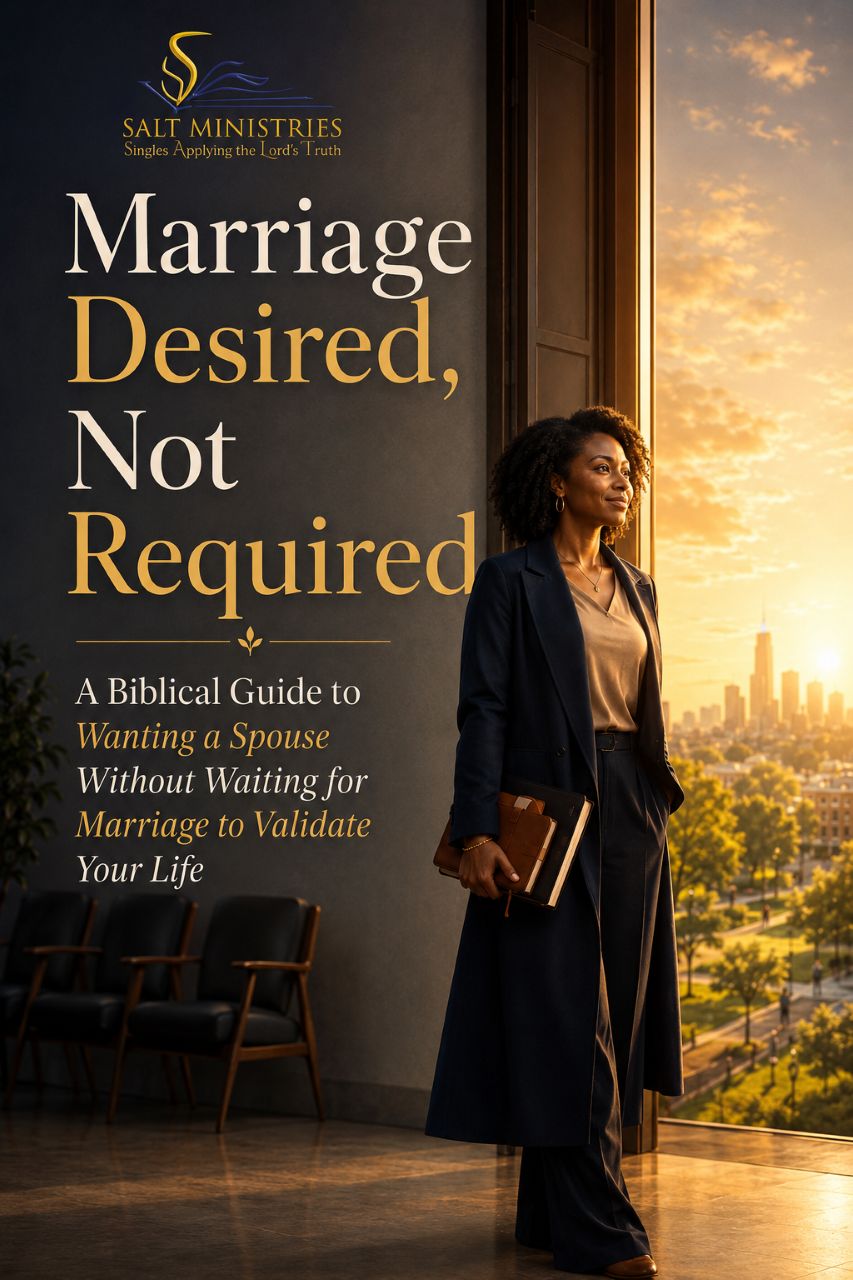
It helps you separate what Scripture actually teaches from assumptions Christian culture may have handed you—and examine the beliefs that can turn a good desire into a verdict about your worth, purpose, or progress.
Get the Details & 2 Bonuses Here!
You may still want marriage deeply.
But you do not need a wedding to be promoted into a life God has already called you to live.